22.5° / North by Northeast Consulting / New York
You already know the problem. I help you create the solution.
I'm Lance. I create the tools for the problem you've already identified. Ten years in client-facing positions and finishing a business degree, I get your product delivered in weeks, not months.
Portfolio
Recent work.
An iOS app, a professional website, and internal software.
Live on the App Store
BUMP: Workout Tracker
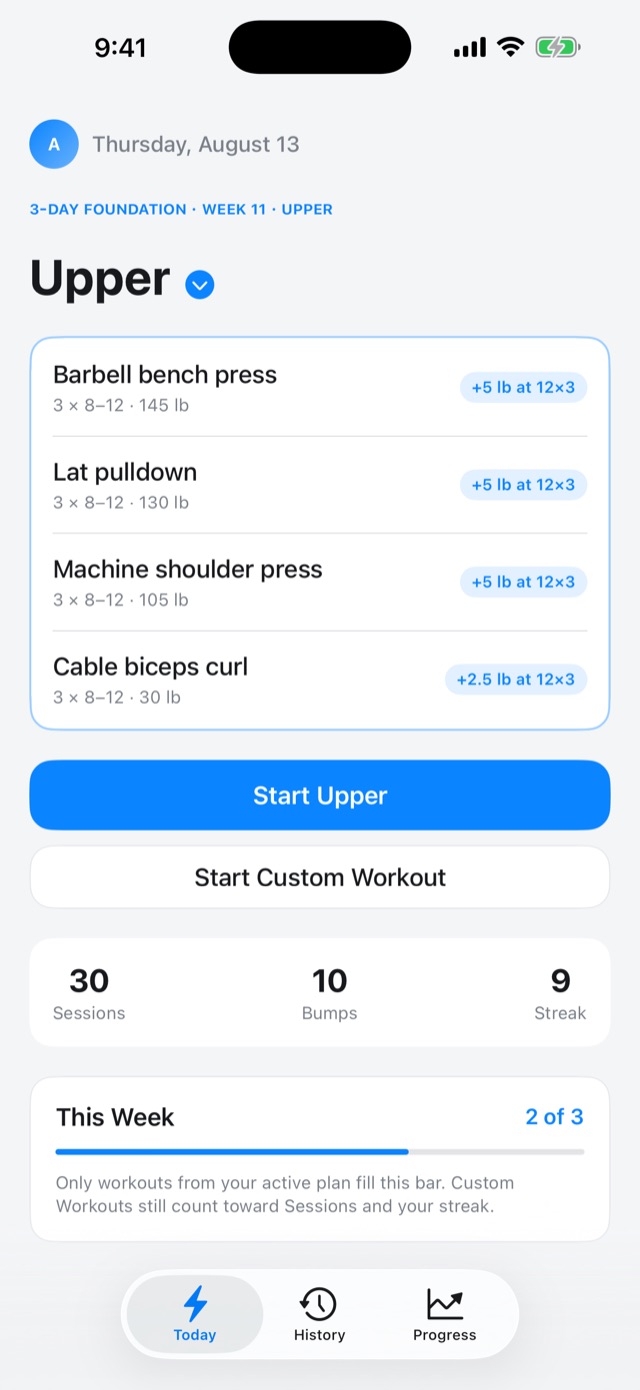
A training log built around one question: what did I lift last time, and is it time to add weight?
No guessing, no notebook, no "I think I did 135 last time?" BUMP puts your last set for that exact exercise in front of you while you're standing at the rack, and tells you when the numbers say to add weight.
I designed it, built it, and shipped it myself. I use it with my own clients.
Open in the App Store →- Platform
- iOS · iPhone
- Role
- Design, build, ship — solo
- Status
- Live · App Store
Read the case study +
The problem
Every training app I'd used was built around history. Charts, volume totals, a year in review. None of that helps you at seven in the morning with a bar in front of you. The only thing you want to know is what you did last time and whether today is the day to add weight.
What I built
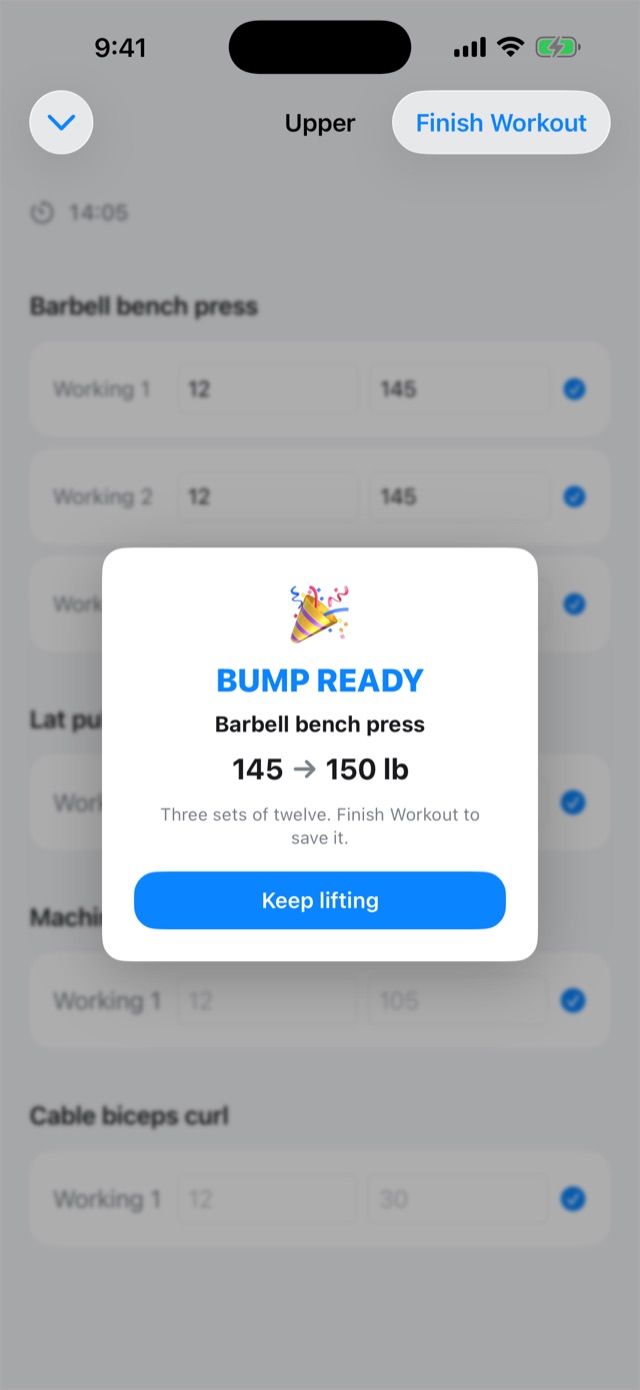
Open the app and today's session is already built from your plan. Each lift shows the weight and reps you hit last time. Log a set and it tells you right there whether the numbers say to go up.
Decisions worth naming
- Client-facing only. No trainer dashboard, no admin side. Building one would have doubled the work and I had no trainers to serve yet.
- Progression is a rule, not a suggestion engine. Hit the top of the rep range on every set and the weight goes up. You always know why it moved.
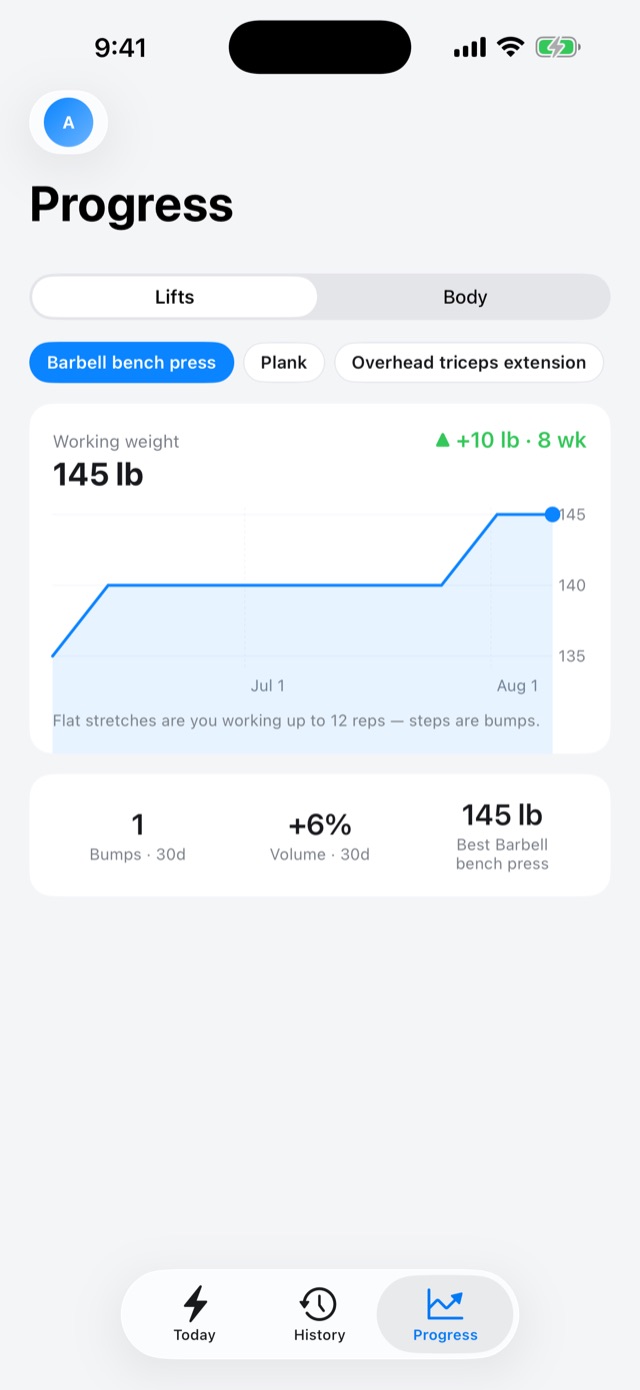
- Charts are in there, but they're a tab you visit. They're not the first thing you see.
Where it stands
Live on the App Store. I built it alone and I use it with my own clients, which is the only reason I trust the defaults.
Your Travel Nanny
A travel childcare service running on referrals, with nowhere to send anyone who wanted to know more. I built the one place that holds all of it: who she is, what the service actually covers, what families have said, and an application that sets up the first consultation.

Read the case study +
The problem
The business ran on referrals, but there was nowhere to send anyone. No single place that explained who Rachele is, what the service actually covers, or how a family starts the conversation. Every one of those answers came out one phone call at a time.
What I built
One place that holds all of it. An about section that introduces her properly, a plain breakdown of what the service includes, reviews from families she's traveled with, and an application that sets up the first consultation without anyone picking up a phone.
Decisions worth naming
- The application asks the fourteen things that used to come out on a first call, so the consultation starts from somewhere instead of from zero.
- No phone number published. She travels for work, and an application she can answer properly beats a call she has to miss.
- The site never collects sensitive identity data. Screening runs through a compliant third-party vendor, so there's no reason a form on her own site should ever ask for a Social Security number.
- It isn't an ad. The referrals were already coming. The job was to give them somewhere to land.
Where it stands
Live at yourtravelnanny.com.
A personal training app, trainer side and client side
The record said the client had lifted a hundred pounds. He couldn't finish a seventy-five-pound warm-up.
Clients rotate between trainers by design, and the logging tool was a spreadsheet with a login. No trainer knew what a client actually lifted last week. I built a working prototype where the app carries the thread: last session, a suggested next session under the owner's own progression rules, confirmed in under thirty seconds on a phone. I scoped it, built it, and pitched it.
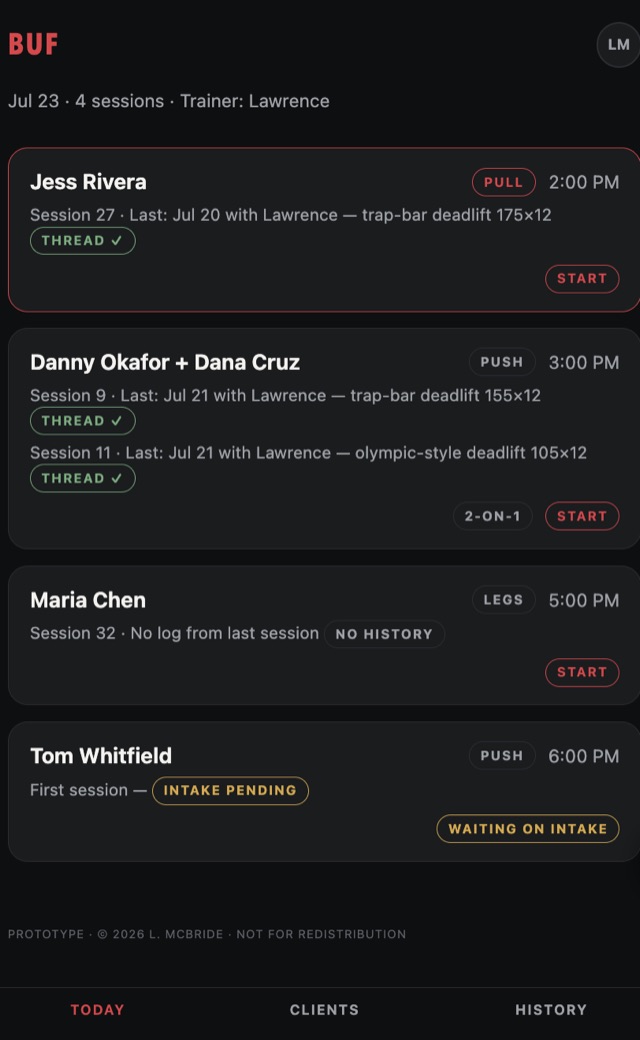
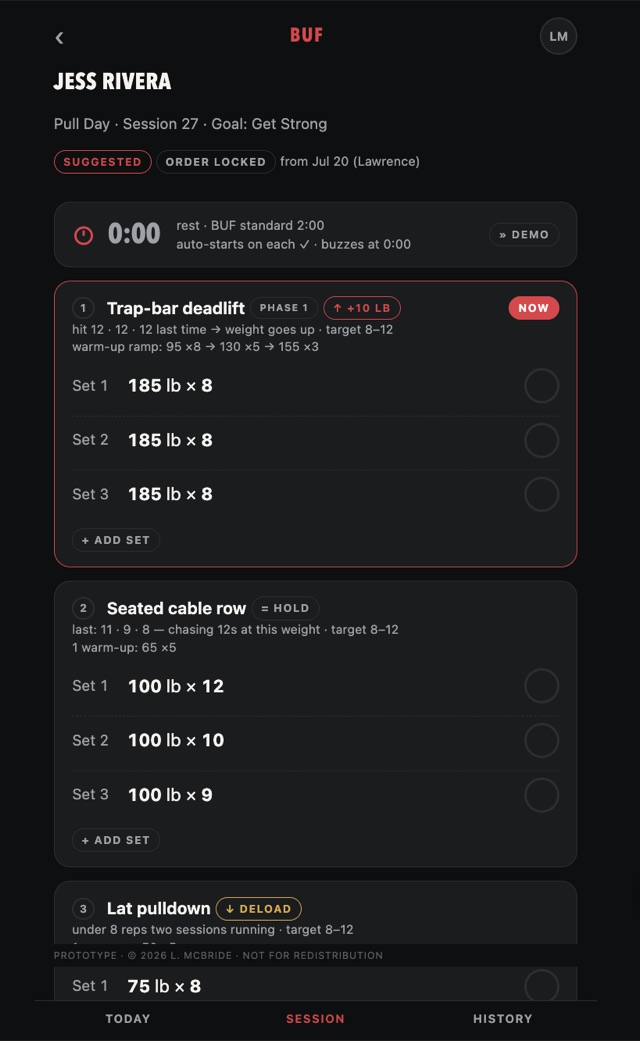
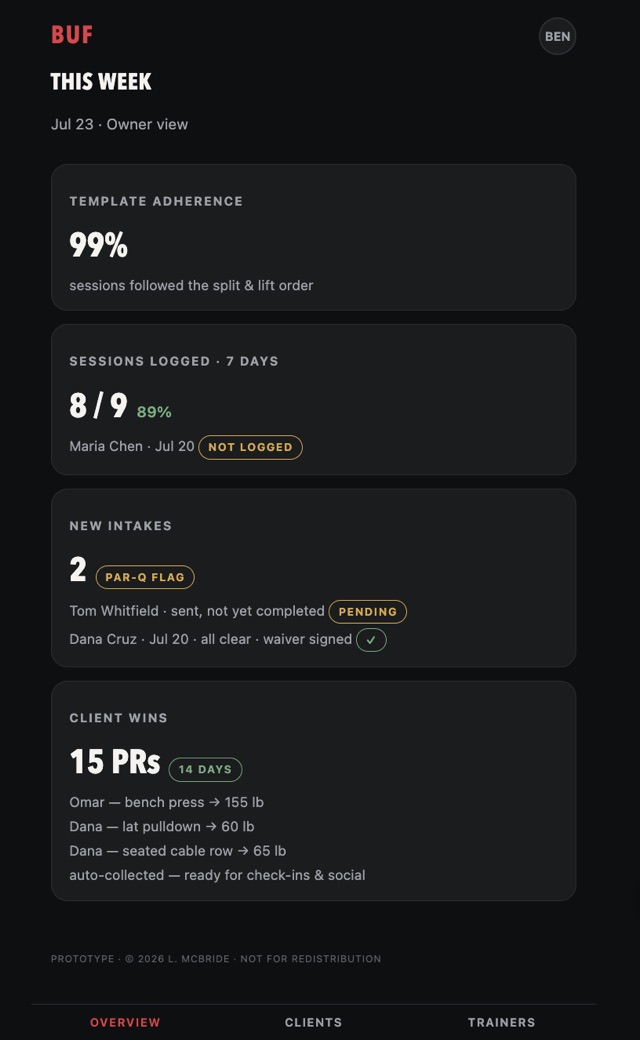
Prototype running on sample data. The names are invented.
Read the case study +
The problem
Clients rotate between trainers by design, which is part of what the gym sells. But the logging tool was a spreadsheet with a login, so trainers skipped it, and nothing carried from one session to the next.
A client once asked me why his numbers kept moving around. The record said he had lifted a hundred pounds. He couldn't finish a seventy-five-pound warm-up, and I had to tell him I didn't know his history.
What I built
A working prototype where the app carries the thread. Each trainer opens to their day. Each client shows what they last lifted and who they lifted it with. The session builds itself from the owner's own split, and every lift arrives with the next weight already worked out.
Decisions worth naming
- The progression rule is the owner's, not mine. Twelve reps on every set and the weight goes up. Between eight and twelve, hold. Under eight twice running, deload. The pitch was to digitize his system. He kept the system.
- Compound lifts appear in a locked order every session. Trainers had been reordering them, which meant the logged numbers couldn't be compared session to session.
- Clients can only enter data during a trainer-started session at the gym. Home workouts would throw off the math.
- Missed logs would show up on the owner's dashboard only. Trainers just see no history. Ben gets the accountability without the floor turning into a scoreboard.
Who I work with
Small operations, real problems.
If you recognize yourself here, we'll probably get along.
Gyms and studios
Scheduling, client tracking, programming. I've worked on this floor for ten years, so you won't spend the first call explaining it.
Service businesses
Intake, quoting, follow-up. The work that happens between a phone call and an invoice, currently living in your head.
Solo operators
One person doing the work of four. These move fastest, because there's nobody to get approval from.
People with an idea
You've described it enough times that you're sick of describing it. Let's find out in two weeks whether it's real.
What I build
Three kinds of work.
Most projects are one of these. A few are two of them stapled together.
Apps
iOS and web
Something people install, open, and come back to. Not a demo, and not something that dies in a folder six weeks in.
Sites
Landing pages
The page you send someone when they ask what you do. Fast, easy to read on a phone, and yours to keep. You're not renting it from a template subscription.
Systems
Tools and automation
The spreadsheet you maintain by hand. The intake form you retype. The report you rebuild every month. None of that should be taking your time.
How it works
Three steps, in order.
A call
Thirty minutes on what you're actually trying to fix. Sometimes the answer isn't software, and I'll say so on that call rather than after you've paid me.
A written scope
Fixed scope, fixed timeline, in writing, before anything gets built. You know what you're getting and when. No hourly surprises.
Weekly builds
Something working in your hands the first week, and every week after. If it's drifting from what you pictured, you find out early enough to steer it.
Why it's fast
One person, and it still ships on time.
I use AI tooling through the whole build. It doesn't write your product for you. What it does is collapse the parts of the work that used to eat weeks: scaffolding, boilerplate, first drafts, the tedious eighty percent.
What's left is the part that needs judgment: what to build, what to leave out, and what happens when a real person uses it wrong. That's where the time goes, and that's what you're paying for.
- No overhead
- No account manager, no handoffs between four people, no markup on someone else's markup. You talk to the person building it.
- No lock-in
- Code, accounts, domain, App Store listing. All in your name from day one. If you want to take it somewhere else later, you can.
- No mystery
- You see progress weekly and you can kill it at any milestone. Long silent build phases are how projects go wrong.
About
Lance McBride

Nobody wants software. They want the friction gone.
I notice inefficiency for a living. Ten years training clients in New York, fifteen before that in food and beverage. Both jobs put me on the floor, watching the same friction happen over and over. The notebook that should be a database. The schedule held together by group texts. The process everyone's annoyed by and nobody owns.
Most people adapt to that friction. I start taking it apart. Always have. It's less a professional skill than a personality trait that finally found a use.
That instinct is why I taught myself to build software instead of just complaining about it. I shipped BUMP, a workout tracking app, to the App Store on my own. Start to finish, no team, no funding, just a problem I understood better than the tools built to solve it.
Most people see a mess and start building the biggest solution they can imagine. I go the other way. What's the smallest thing that actually fixes this? Sometimes that's one screen, not a platform.
NXNE Consulting is that instinct with a name on it. Custom web apps, workflow automation, small focused tools, for people running a business without a developer on staff and no interest in hiring an agency. I'm working on a business admin degree too, rounding out the eye for what's broken with the skills to run the business side of fixing it.
“North by Northeast: 22.5 degrees. A bearing, not a destination.”
NXNE Consulting LLC · New York, NY
Questions
Before you write.
How long does something take?
A landing page, days. An internal tool, a couple of weeks. A real app, roughly six to twelve weeks depending on scope. You get a specific date in writing before anything starts.
What does it cost?
It depends on scope, and I'd rather quote you honestly than post a number that's wrong for your project. You'll have a fixed price before you commit to anything.
Do I own what you build?
Yes. Code, accounts, domain, listings, all in your name from the first day.
I don't know what I need yet.
That's most people, and it's fine. Bring the problem, not the spec. Figuring out what to build is the first half of the job.
Contact
Tell me what's broken.
A paragraph is plenty. If it's a fit I'll say so, and if it isn't I'll tell you that too.
What happens next
I read everything that comes through here and reply within one business day, including when the answer is that I'm not the right fit for it.
No newsletter, no drip sequence, no sales call you didn't ask for.
Rather just email? lance@nxne.ai